9 Cognitive Biases in Daily Life That Affect Your Thinking
Cognitive biases in daily life quietly guide our thoughts from the moment we wake up. They influence what we believe, who we trust, what we buy, and even how we judge ourselves. Most of the time, we’re not doing anything “wrong.” Our brain is simply trying to make life easier by taking shortcuts. From the choices we make to the opinions we hold, our brain constantly takes shortcuts to save time and energy. These shortcuts are helpful—but they also quietly distort how we see the world.
The problem is that these shortcuts don’t always lead us to the best decisions.
If you’ve ever said, “I knew it!”, “Everyone thinks this way”, or “Why do I keep overthinking this?”, you’ve already met cognitive bias—whether you knew it or not.
What Are Cognitive Biases?
Cognitive biases are patterns of thinking that influence our judgments and decisions. Instead of carefully analyzing everything, our brain relies on quick assumptions based on past experiences, emotions, and context.
This is helpful when you’re busy or tired. But it also means your brain sometimes jumps to conclusions, exaggerates problems, or ignores useful information. The key is not to fight your brain—but to understand it.
Below are nine common cognitive biases in daily life, explained in a simple and relatable way.
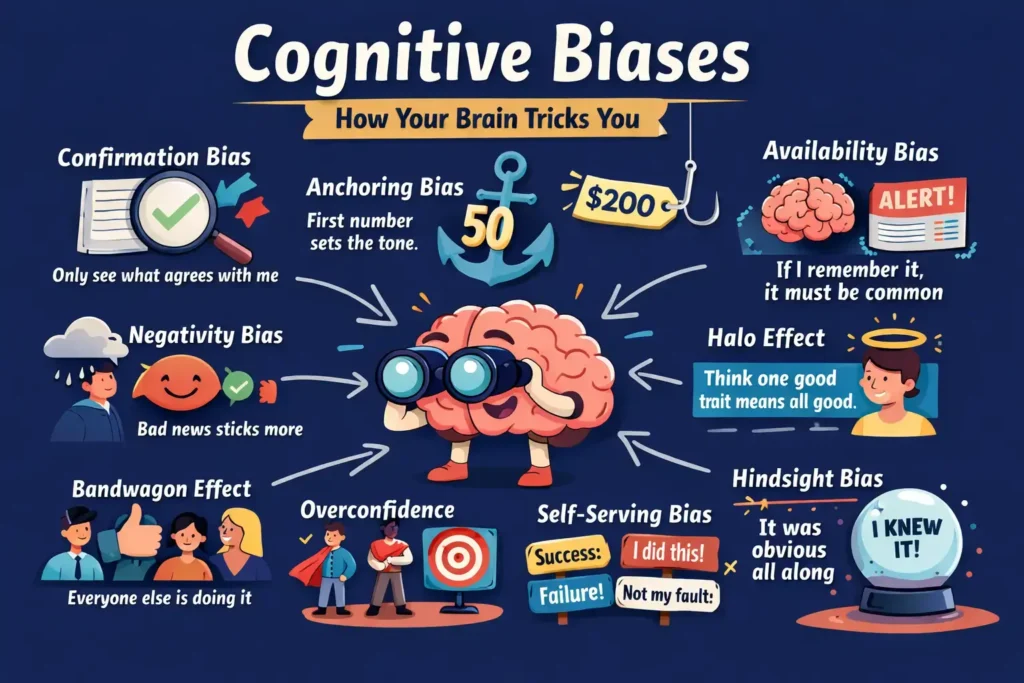
1. . Confirmation Bias: How We Only See What We Already Believe
“I Already Believe This, So I’ll Stick With It”
Confirmation bias is when you notice only the things that support what you already believe and ignore anything that challenges it.
Let’s say you think mornings are unproductive. On days when you feel tired in the morning, you tell yourself, “See? Mornings are useless.” But on days when you’re energetic and focused early, you brush it off as a rare exception.
Your brain prefers being right over being curious. It quietly builds a case to support the belief you already have. Simply put, we don’t want to be wrong, so we subconsciously protect our opinions.
This bias shows up everywhere—politics, relationships, health advice, simple arguments, and even small decisions. Your brain is basically saying, “I like my opinion. Let’s keep it.” This bias keeps us comfortable—but it also keeps us stuck.
2. Availability Bias: Why What Feels Common Feels True
“This Feels Common, So It Must Be”
Availability bias happens when we judge how likely or important something is based on how easily it comes to mind.
If a friend recently had a health issue, you may suddenly feel that the same thing could happen to you—even if the actual risk hasn’t changed. What feels close feels bigger. Or If someone you know recently lost their job, you might start feeling that job loss is everywhere and that your own job isn’t safe. Even if nothing has actually changed, the fear feels real because the example is close to you.
Our brain mistakes vivid memories for accurate information. It confuses recent with frequent. That’s why emotional stories stick more than statistics, and personal experiences feel bigger than facts.
3. Anchoring Bias: The Power of First Impressions
“The First Thing I Hear Sets the Tone”
Anchoring bias means we rely too much on the first piece of information we receive.
If someone says a task will take five minutes and it ends up taking twenty, it feels longer and more frustrating—even if twenty minutes is reasonable. The first estimate becomes the anchor. Or imagine shopping online and seeing a product marked “Originally $1,000, now $400.” The original price becomes the anchor. Compared to it, $400 feels cheap—even if the product is only worth $200.
First impressions and first numbers quietly shape expectations. This happens in shopping discounts, salary negotiations, exams, and real estate prices more than we realize. Once an anchor is set, our brain struggles to move away from it.
4. Halo Effect: When One Good Trait Changes Everything
“One Good Thing Means Everything Is Good”
The halo effect occurs when one positive trait influences how we see everything else.
For example, if someone is attractive and confident, we often assume they are intelligent, kind, and smart. Or a well-designed product is often assumed to be high quality, even before we test it. And the same happens with people we like. We excuse their flaws while being stricter with others. Celebrities being trusted on topics they know nothing about
Our brain fills in the gaps without checking facts. One strong impression creates a full picture—accurate or not. In daily life, it affects hiring decisions, friendships, social media influence, and leadership roles. Our brains love neat, positive stories—even when reality is more complex.
5. Negativity Bias: Why Bad Moments Stick Longer
“Why Do Bad Moments Stay Longer?”
Negativity bias is the reason one awkward moment can stay in your head for years, while dozens of good moments fade away quickly. It explains why one small mistake can overshadow many successes.
You receive 10 compliments on your work and 1 criticism. Which one do you think about all night? Exactly. The criticism. Even if your manager praises most of your performance, one small criticism can dominate your thoughts for days. This isn’t because you’re weak—it’s because your brain is wired to notice threats.
In daily life, this bias causes overthinking, self-doubt, and unnecessary stress. This keeps us alert—but it also makes us unnecessarily hard on ourselves.
6. Bandwagon Effect: Following the Crowd Without Noticing
“If Everyone Thinks This Way, I’ll Go Along”
The bandwagon effect is when we adopt opinions or behaviors because they seem popular.
You might not strongly agree with an opinion, but when you see many people supporting it online, you feel pressure to accept it or stay quiet. Fitting in feels safer than standing out. Or you assume a movie is good because it’s popular, even if you don’t enjoy it.
Sometimes we don’t change our minds—we just change our behavior to match the crowd.
This bias is everywhere—trends, viral opinions, fashion, investing, and social media outrage. When something is popular, our brain assumes it must be correct or valuable. Belonging feels safe. Going against the crowd feels uncomfortable. As a result, we sometimes stop thinking critically and start copying the majority without question. This bias connects us socially, but it weakens independent thinking.
7. Overconfidence Bias: Thinking We Know More Than We Do
“We Think We Know More Than We Do”
Overconfidence bias occurs when we overestimate our knowledge, Skills, abilities, or judgment.
For example, someone may watch a few videos and believe they fully understand fitness, investing, or mental health. This confidence can prevent learning and increase mistakes. Most people think they’re above average at driving, communication, and decision-making—which statistically can’t be true.
We skip instructions, ignore advice, or jump into decisions too quickly because we believe we understand more than we actually do. Later, when things don’t go as planned, we’re surprised. Confidence helps—but unchecked confidence hides blind spots. In daily life, overconfidence bias affects careers, relationships, health decisions, and arguments.
8. Self-Serving Bias: Protecting Our Self-Esteem
“Success Is Me. Failure Is Something Else.”
Self-serving bias is the habit of taking credit for success and blaming outside factors for failure.
When things go well, we believe it’s because we’re skilled or capable. When things go wrong, we blame timing, circumstances, or others. In short:
👉 Success = “I did great”
👉 Failure = “It wasn’t my fault”
Almost everyone does this. Quietly. Automatically. Without realizing it. For example, You do well on an exam. You think: “I worked hard. I’m smart.” You do badly on an exam. You think: “The questions were unfair. The teacher didn’t explain properly.” Or in relationships, If things are going well, you think it’s because you’re understanding and caring. If there’s conflict, you think the other person is difficult or insensitive.
Same person. Same situation. Different explanation. That’s self-serving bias at work.
None of this makes you dishonest. Feeling capable, intelligent, and “good enough” helps us function in the world. So when something goes wrong, blaming ourselves fully can hurt. The brain steps in and says, “Let’s soften this.” It’s emotional self-defense. Our brain likes to protect our self-esteem.
The gentle way to handle this bias is simple, honesty. When something goes wrong, ask yourself what part you could improve next time. When something goes right, also acknowledge the help, timing, or support that made it possible.
9. Hindsight Bias: “Why Events Feel Predictable After the Fact”
“I Knew This Would Happen”
Hindsight bias is the feeling that something was obvious after it has already happened. Once we know the outcome, our brain rewrites the story and tells us we saw it coming all along—even when we didn’t.
You’ve probably said this before: “I knew this would happen.”
Most of the time, that’s hindsight bias talking.
For example, After getting a low score, you think: “I knew it, I should have studied that chapter more.” Or after a major event happens, people say:
“This was bound to happen.” Or when a new job doesn’t work out, you think: “I had a bad feeling about this from the start.”
This bias makes us judge ourselves and others unfairly and overestimate our ability to predict the future. This bias fades when we replace judgment with understanding—and understanding makes room for growth.
| Cognitive Bias | What It Does |
|---|---|
| Confirmation Bias | Reinforces existing beliefs |
| Negativity Bias | Focuses on bad experiences |
| Anchoring Bias | Fixates on first information |
| Bandwagon Effect | Follows the crowd |
| Halo Effect | Judges whole based on one trait |
Final Thoughts
Cognitive biases in daily life don’t just affect big decisions. They shape small moments too—how we read a message, judge someone’s tone, or how we see ourselves after a long day. When we don’t notice these biases, we react automatically. When we do notice them, we create space to respond differently. That small pause can change everything. Slow down strong reactions. Question first impressions. Stay curious instead of defensive. Awareness doesn’t make you perfect—but it makes you wiser.
Cognitive biases in daily life are not flaws—they are shortcuts. But shortcuts aren’t always the best route.
The more you understand how your mind works, the kinder you become—to others and to yourself. And that understanding is far more powerful than being “right.”
FAQ’s About Cognitive Biases
What are cognitive biases in psychology?
Cognitive biases are mental shortcuts the brain uses to process information quickly. While efficient, they can distort judgment and decision-making.
What are the most common cognitive biases in daily life?
Common cognitive biases include confirmation bias, negativity bias, availability bias, anchoring bias, and the bandwagon effect.
How do cognitive biases affect decision making?
They influence how we judge risks, interpret information, evaluate others, and make choices—often without conscious awareness.
Can cognitive biases be reduced or avoided?
They cannot be eliminated, but awareness, slowing down decisions, questioning assumptions, and seeking opposing viewpoints can reduce their impact.
Why does the brain rely on cognitive biases?
The brain uses cognitive biases to save time and energy. They help us function efficiently but sometimes sacrifice accuracy.
Read my 9 Things That Hold Great Power for Emotional Independence blog here.
Subscribe and Never Miss a Motivational Boost !!